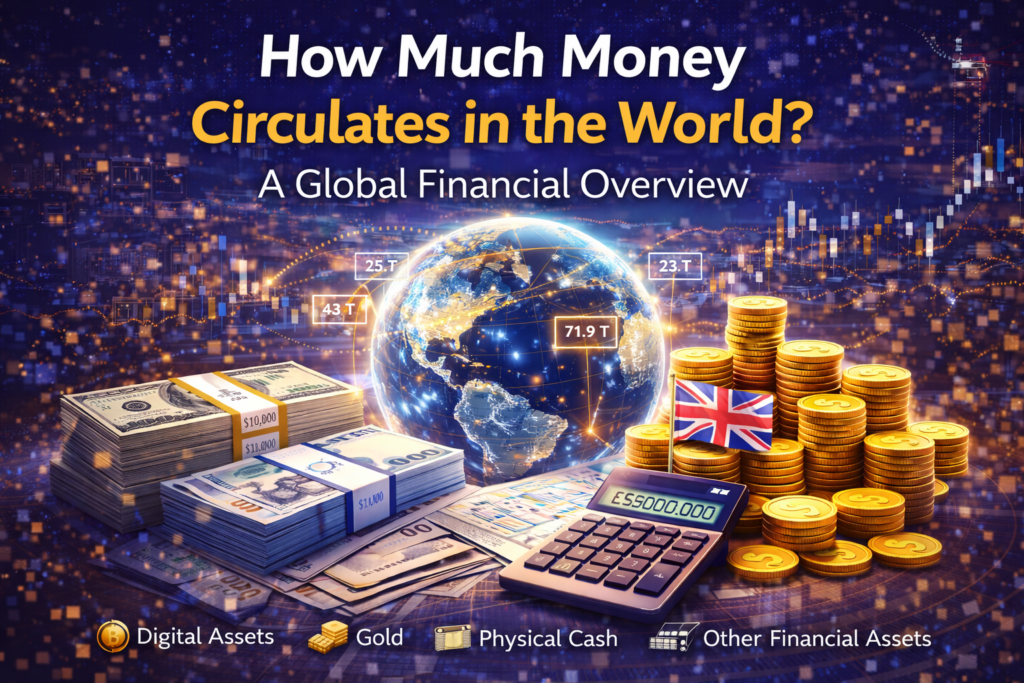
How Much Money Circulates in the World? A Global Financial Overview
Money is at the center of the global economy, shaping trade, investment, and economic growth across countries. Many people wonder how much money actually circulates in the world. While it is difficult to calculate an exact number, economists estimate the total value of global money by analyzing physical currency, bank deposits, and digital financial assets.
The Total Amount of Money in the World
When we talk about money circulating globally, we usually refer to different categories. Physical money such as banknotes and coins represents only a small part of the global financial system. The majority of money today exists in digital form, including bank accounts, investments, and electronic transactions.
Estimates suggest that the total global money supply, including cash and bank deposits, is worth approximately:
- $90 trillion to $120 trillion worldwide
This includes money stored in banks, savings accounts, and financial systems across the globe.
Physical Cash vs Digital Money
Physical money (coins and banknotes) represents only a small percentage of global wealth. It is estimated that:
- Global physical cash is around $8 trillion to $10 trillion
The rest exists as digital balances in banking systems. This shows how modern economies rely heavily on electronic payments and financial technology.
Global Wealth and Financial Assets
If we include financial assets such as stocks, bonds, and investments, the total global financial value becomes much larger. Some estimates place the total global wealth at:
- More than $400 trillion
This includes:
- Real estate
- Stock markets
- Corporate assets
- Investment funds
However, this figure represents wealth, not only circulating money.
Why Money Supply Changes
The amount of money circulating in the world changes constantly. Governments and central banks increase or decrease money supply to support economic stability. For example, during economic crises, central banks may inject more money into the system to support businesses and financial markets.
Technology also plays a major role. Online banking, mobile payments, and digital financial platforms have increased the speed and volume of money circulation worldwide.
The Role of Major Economies
The largest portions of global money are concentrated in major economies such as:
- United States
- European Union
- China
- Japan
These regions control a large part of global financial activity through strong banking systems and large markets.
The Growth of Digital Finance
In recent years, digital transactions have become dominant. People use online banking, credit cards, and mobile payment apps more than ever. This shift has made money movement faster and more efficient, contributing to the rapid circulation of capital worldwide.
FinTech companies have also transformed how money is transferred, invested, and managed globally.
Economic Impact of Global Money Circulation
Money circulation supports international trade, investment, and economic growth. Businesses rely on financial systems to operate, while individuals depend on banks for savings, loans, and payments.
The faster money moves in an economy, the more opportunities it creates for development and innovation.